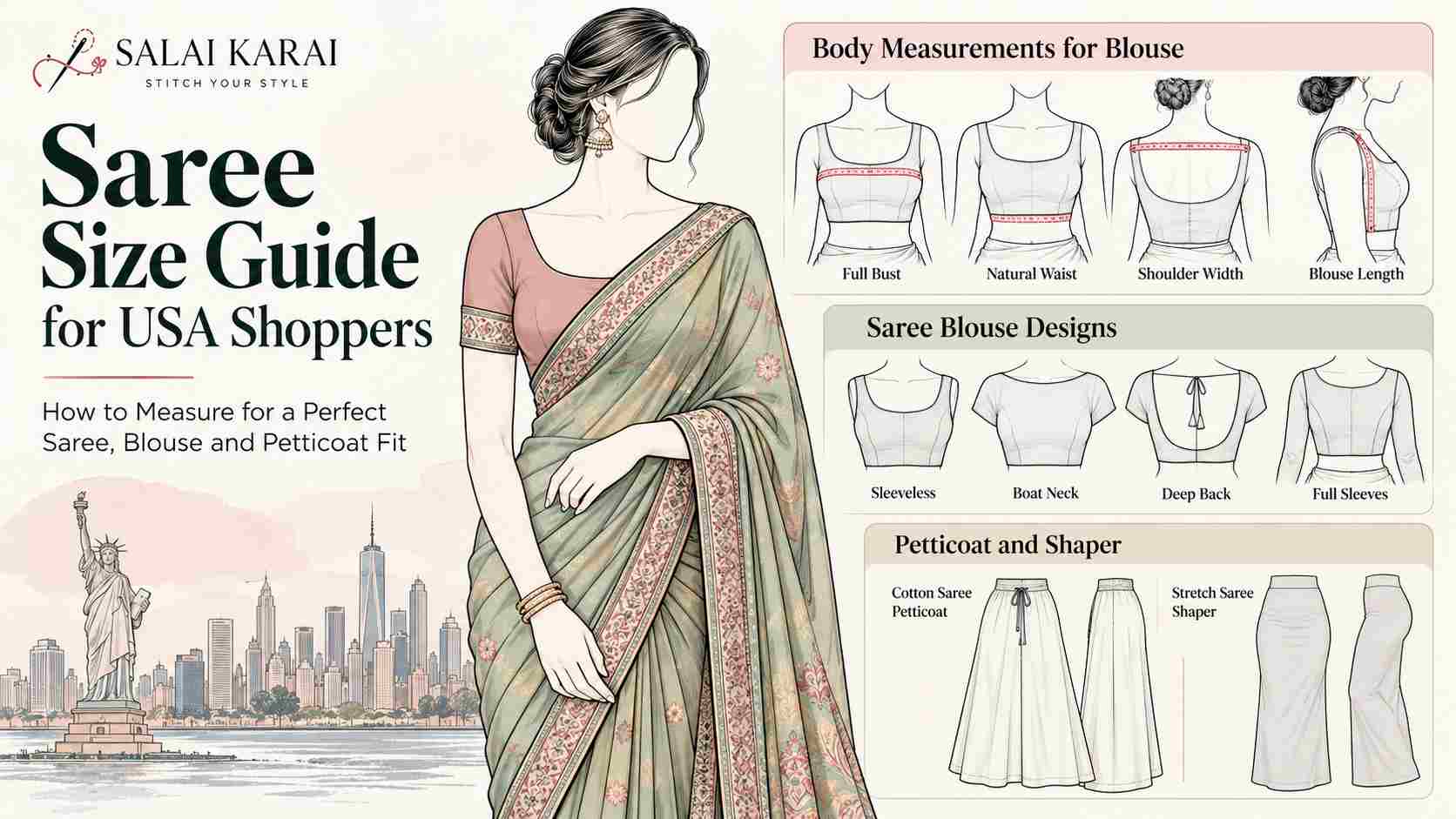
How to Measure for a Perfect Saree, Blouse and Petticoat Fit
A saree drape is free-size, but a great saree look is not. The blouse, the petticoat and the length of the drape all depend on your measurements.
Ordering from the US means you can’t pop into a tailor’s shop for a trial. This guide shows you how to measure yourself at home in 10 minutes, in inches, so your saree fits the first time.
What you need before you start
- A soft measuring tape (the fabric kind, not a metal one)
- A friend to help with the back and shoulder measurements
- The bra you will wear with the saree, and the heels you plan to wear
- A well-fitting blouse or fitted top, as a backup reference
Stand straight and relaxed. Keep the tape snug but not tight; you should be able to slip one finger under it.
How long is a saree? (yards and meters)
A standard saree is about 5.5 meters long, or roughly 6 yards. Most also come with an attached blouse piece of about 0.8 to 1 meter.
| Saree type |
Length |
Width |
Notes |
| Standard saree (no blouse piece) |
5–5.5 m (5.5–6 yd) |
1.1–1.3 m (43–51 in) |
The everyday drape length |
| Saree with attached blouse piece |
6–6.5 m (6.5–7 yd) |
1.1–1.3 m |
Blouse piece is cut off before stitching |
| Ready-to-wear (pre-stitched) saree |
Fixed by size |
— |
Ordered by waist and length, not yards |
The saree’s own length rarely needs adjusting. Height matters more for the petticoat and for how many pleats you make. Taller women (5’8″ and up) may prefer a 6-yard drape for fuller pleats and a longer pallu.
How to measure your body, step by step
Write each number down as you go. Use the record sheet further below.
- Full bust: Wrap the tape around the fullest part of your chest, under the arms, keeping it level across the back. Wear the bra you will wear on the day.
- Under-bust: Measure right under the bust, where a bra band sits. This sets where a short saree blouse ends.
- Natural waist: Measure the narrowest part of your torso, usually an inch or two above the navel.
- Saree waist (petticoat waist): Measure where you will tie the saree, usually at or just below the navel. This is different from your natural waist and is the number petticoats and ready-to-wear sarees use.
- Hips: Measure around the fullest part of your hips and seat, feet together.
- Shoulder width: Measure across the back from one shoulder bone to the other, at the point where a sleeve seam would sit.
- Blouse length: From the highest point of your shoulder (near the neck), down over the bust, to where you want the blouse to end.
- Armhole: Loop the tape around the top of your arm, through the armpit and over the shoulder joint.
- Sleeve length: From the shoulder edge down your arm to where you want the sleeve to end (cap, elbow or full).
- Sleeve round: Around the widest part of your arm at the sleeve’s end point (bicep for short sleeves, forearm or wrist for long).
- Petticoat length: From your saree waist straight down to the floor, wearing your heels. Subtract half an inch so the hem clears the ground.
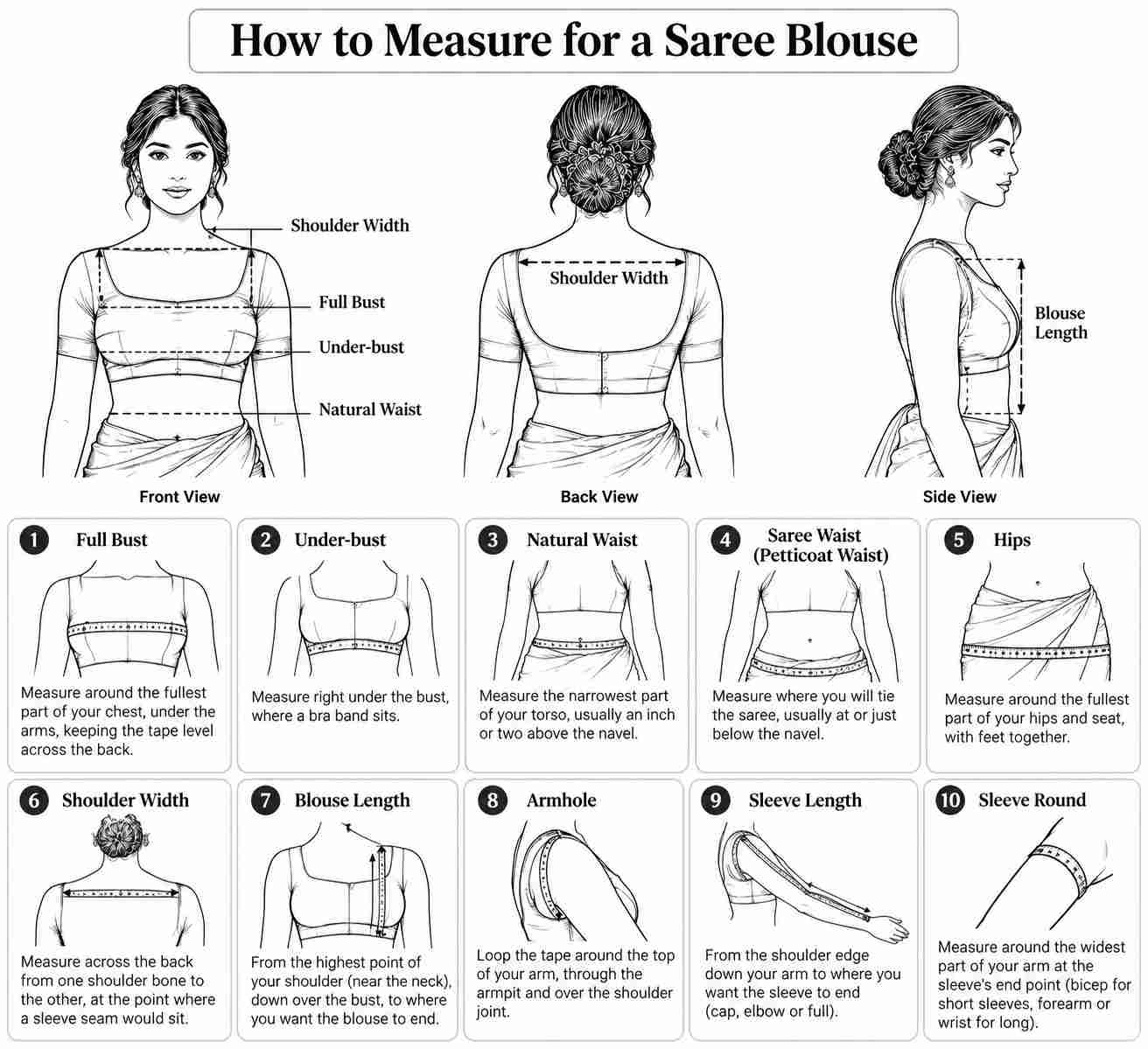
How to measure for a saree blouse
The blouse is the only part of a saree that is truly fitted. Beyond the basics above, a tailor needs four more numbers:
- Front neck depth: From the base of your neck (where a necklace sits) straight down to where you want the neckline to end.
- Back neck depth: From the bone at the back of your neck down to where you want the back opening to end.
- Apex (shoulder to bust point): From the high shoulder point down to the fullest point of the bust. This places darts so the blouse doesn’t pucker.
- Apex distance: The straight distance between the two bust points.
If you’re unsure about any of these, measure a blouse or fitted top that already fits you well. Lay it flat and measure across it, then double the chest and waist numbers.
How blouse measurements change with the design
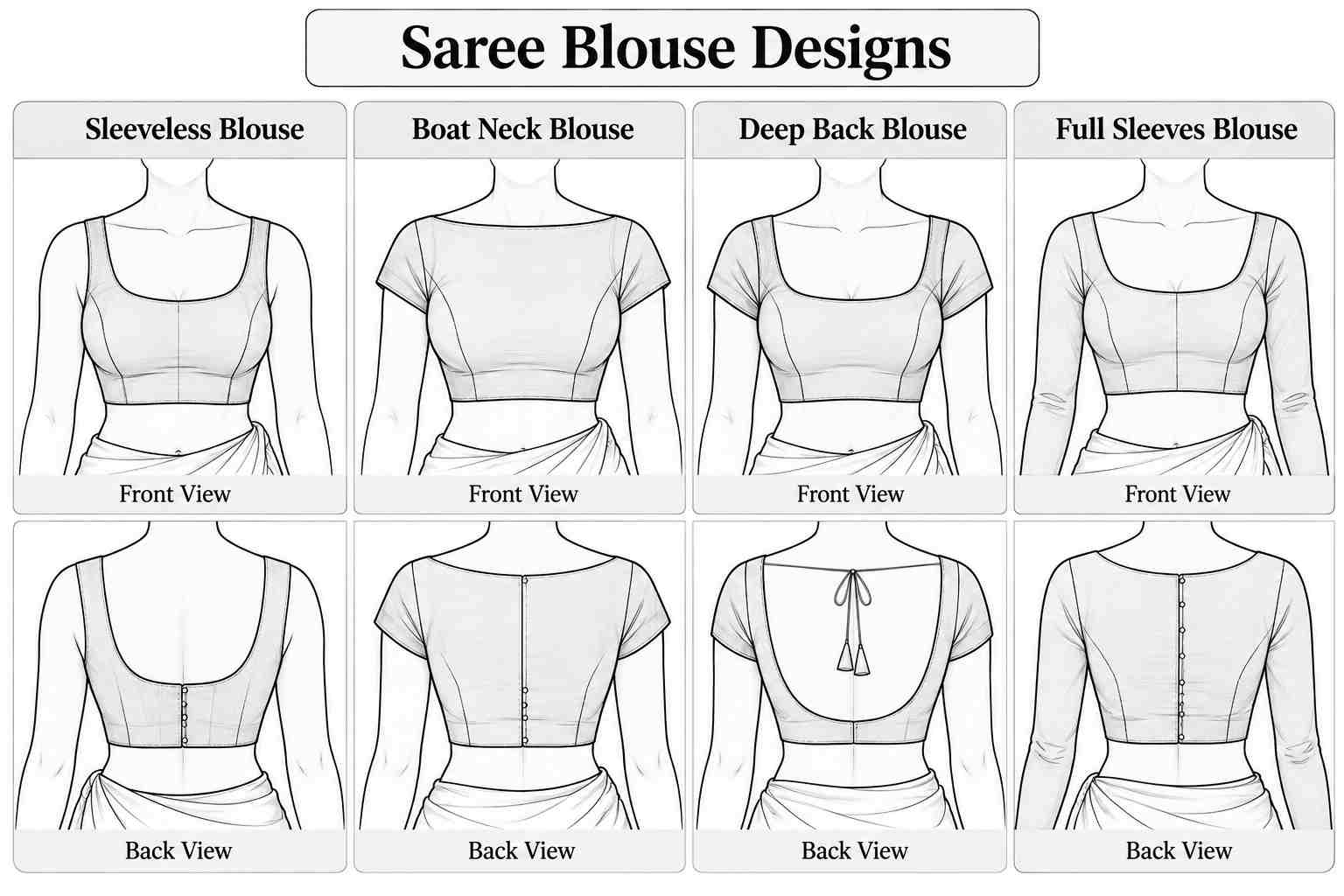
The same body gives different numbers depending on the blouse style. Choose your design first, then measure for it.
| Blouse design |
Measurements that matter most |
What changes |
| Classic short sleeve, round neck |
Bust, shoulder, armhole, sleeve round |
The standard set; easiest to fit |
| Sleeveless |
Armhole, shoulder |
Armhole is cut closer so the bra doesn’t show; give an exact armhole |
| Deep back / backless |
Back neck depth, under-bust |
Needs hooks, a tie-up or a padded build; plan your bra before measuring |
| Boat neck |
Shoulder width, front and back neck depth |
Neck runs wide toward the shoulder, so shoulder width must be precise |
| High neck / collar |
Neck round (around the base of the neck) |
Add a neck round measurement; leave a finger of ease |
| Elbow or full sleeves |
Sleeve length, bicep, forearm, wrist round |
Measure the round at every point the sleeve passes |
| Long or crop-top style blouse |
Blouse length, natural waist |
Ends near the waist instead of under the bust; length decides the look |
| Princess cut / katori cut |
Apex, apex distance, under-bust |
Panels are shaped to the bust point, so apex numbers must be exact |
| Padded blouse |
Full bust measured without a bra |
Padding replaces the bra; tell the tailor it is padded |
What to wear under a saree: petticoat and shapewear sizing
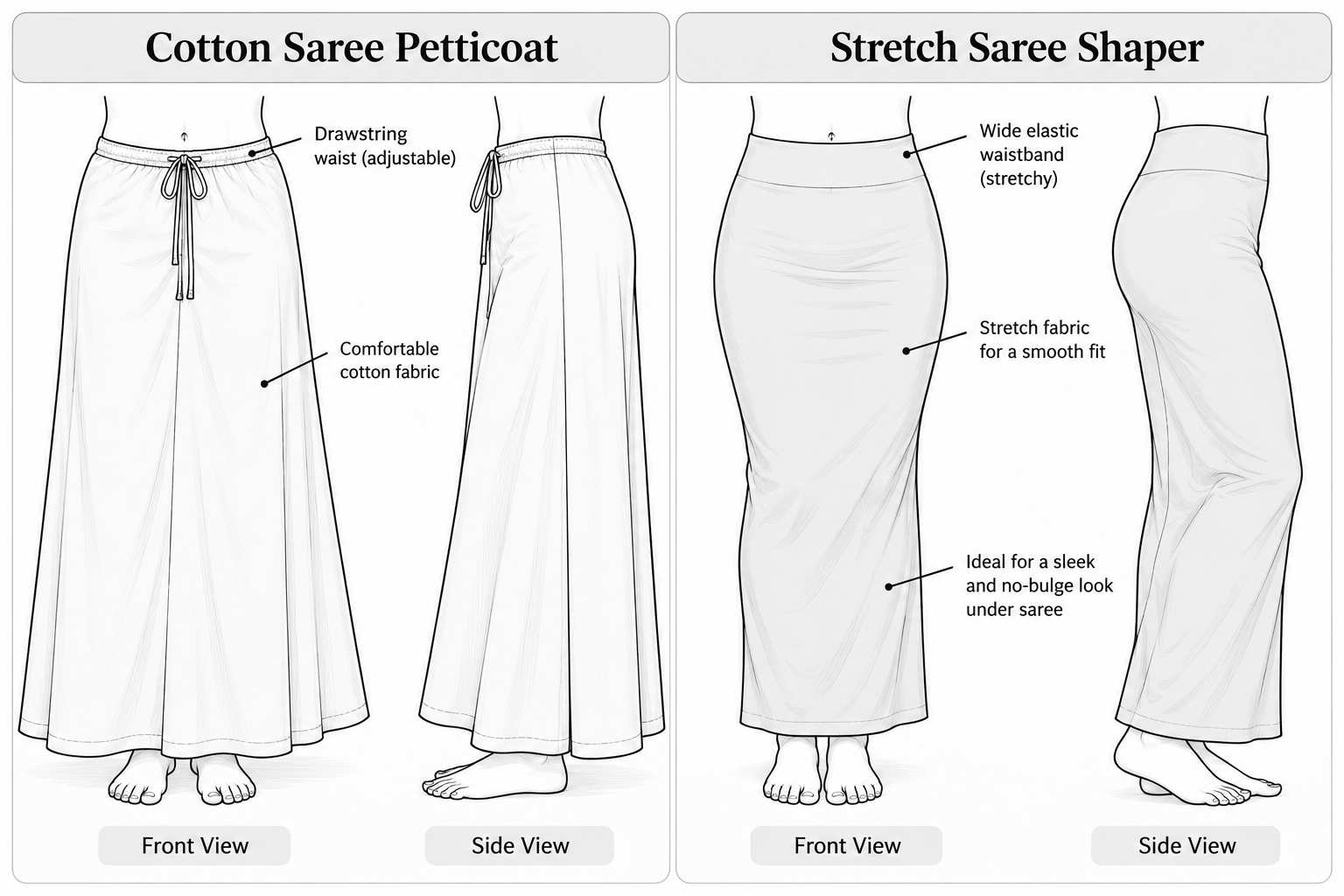
Under a saree you wear a petticoat (also called an underskirt) or a saree shaper. Both are sized by your saree waist and your length, not by your dress size.
- Cotton petticoat: Drawstring waist, so it adjusts. Get the length right: saree waist to floor in your heels, minus half an inch.
- Saree shaper (shapewear petticoat): Stretch fabric with a fitted waist and a flared or mermaid hem. Buy by your saree waist and hip. It holds pleats firmly and gives a slimmer line.
- Color: Match the petticoat to the saree’s base color, especially for sheer net, chiffon and organza sarees.
Your shoes change your petticoat length
Decide what shoes to wear with your saree before you measure. A 3-inch heel needs a petticoat 3 inches longer than flats. The saree’s hem should just brush the top of your foot and skim the floor.
- Flats or juttis: measure barefoot, subtract half an inch.
- Block heels or wedges: measure in them; good for long events and outdoor venues.
- Stilettos: measure in them; best for evening receptions.
Saree blouse size chart (US sizes, inches)
Use this as a starting point. Always check the size chart on the product page, since stitched sizes vary by design.
| US size |
Letter |
Bust |
Natural waist |
Hips |
Shoulder |
| 2–4 |
XS |
32–33 |
25–26 |
35–36 |
13.5 |
| 6–8 |
S |
34–35 |
27–28 |
37–38 |
14 |
| 10–12 |
M |
36–38 |
29–31 |
39–41 |
14.5 |
| 14–16 |
L |
39–41 |
32–34 |
42–44 |
15 |
| 18–20 |
XL |
42–44 |
35–37 |
45–47 |
15.5 |
| 22–24 |
2XL |
45–47 |
38–40 |
48–50 |
16 |
These are body measurements. The tailor adds about 1 to 2 inches of ease to the bust so you can move, sit and dance.
Your measurement record sheet
Copy this table, fill in your numbers and keep it on your phone for every order.
| Measurement |
Your number (in) |
| Full bust |
|
| Under-bust |
|
| Natural waist |
|
| Saree waist |
|
| Hips |
|
| Shoulder width |
|
| Blouse length |
|
| Armhole |
|
| Sleeve length |
|
| Sleeve round |
|
| Front neck depth |
|
| Back neck depth |
|
| Apex / apex distance |
|
| Petticoat length (in heels) |
|
How fabric changes the fit
Fabric changes how a blouse and saree sit on the body, so the same numbers can feel different.
- Velvet: Thick with no stretch. Ask for an extra half inch of ease at the bust and armhole.
- Net and organza: Sheer, so the blouse needs a lining. A lined blouse fits slightly snugger.
- Chiffon and georgette: Light and fluid. These drape close to the body and are the easiest fabrics to wear if you want to look slim in a saree.
- Heavy embroidery or sequin work: No give at all. Keep at least 1 to 1.5 inches of seam allowance so the blouse can be let out later.
- Stretch blouses: Forgiving across sizes; good for gifting or when you can’t measure.
Sizing a ready-to-wear saree
A ready-to-wear saree has pleats and pallu already stitched in. You order it like a skirt.
- Size it by your saree waist and hips, not your bust.
- Give your height and the heel you’ll wear so the length is right.
- The blouse is ordered separately by the blouse measurements above.
Common measuring mistakes
- Measuring over bulky clothes instead of a thin layer
- Using your jeans size instead of a real saree-waist measurement
- Pulling the tape tight, which makes the blouse too small
- Measuring the bust in a different bra than the one you’ll wear
- Forgetting your heels when measuring petticoat length
Between two sizes?
Go one size up. A tailor can take a blouse in easily, but can only let it out if there is spare seam allowance. If you’re between sizes, choose custom stitching and send your exact numbers.
Frequently asked questions
- How do I measure for a saree blouse at home? You need a soft tape and a friend. Measure your full bust, under-bust, waist, shoulder width, blouse length, armhole, sleeve length and sleeve round, plus front and back neck depth for your chosen design.
- How long is a saree? A standard saree is about 5.5 meters (6 yards) long and 1.1 to 1.3 meters (43 to 51 inches) wide. Sarees with an attached blouse piece run 6 to 6.5 meters.
- How many yards of fabric are in a saree? About 5.5 to 6 yards for the drape, or 6.5 to 7 yards including the blouse piece.
- What should I wear under a saree? A petticoat or saree shaper in the saree’s base color, and a bra that suits your blouse style. Size the petticoat by your saree waist and floor length in your heels.
- What shoes should I wear with a saree? Any heel works, as long as you measure your petticoat length in those exact shoes. Block heels are comfortable for long weddings; stilettos suit evening receptions.
- Should I size up or down for a saree blouse? Size up if you’re between two sizes. A blouse can be taken in, but it can rarely be let out.
- Do I need different measurements for a sleeveless or backless blouse? Yes. Sleeveless blouses need an exact armhole. Backless and deep-back blouses need your back neck depth and a plan for your bra before you measure.
- Is a saree one size fits all? The drape itself is free-size. The blouse, petticoat and any ready-to-wear saree must be sized to your body.
Find your fit and shop
Once you have your numbers, browse the full Pakistani saree collection. Planning a function? See wedding sarees or the light, easy-to-fit chiffon sarees. For winter events, velvet sarees pair best with the extra ease noted above.
All orders ship across the USA, Canada, Australia and other countries. Check our shipping and exchange policy pages for current delivery times and size-exchange terms.